USD Structure#
The stage structure of the OpenUSD Digital Twin mostly follows the Guidelines for Structuring USD Assets from the USD Assets Working Group.
Flat and accessible hierarchies are a key aspect of the stage structure as shown in the diagram below highlighting the commonly used nodes and their names.
/asset                                  (xform) ← No transformation applied
    /geo                                (xform)
        /render                         (scope) ← Purpose: render
            /mesh_1                     (mesh)
                /grip_material          (material) ← Reference to /asset/materials/grip_material + overwrites
            /mesh_2                     (mesh)
                /grip_material          (material) ← Reference to /asset/materials/grip_material + overwrites
            /artwork_mesh_1             (mesh)
                /grip_artwork_material  (material) ← Reference to /asset/materials/grip_artwork_material
            /artwork_mesh_2             (mesh)
                /grip_artwork_material  (material) ← Reference to /asset/materials/grip_artwork_material
            ...
    /materials                          (scope)
        /_artwork_controller            (shader)
        /grip_material                  (material)
        /grip_artwork_material          (material)
Each Digital Twin has a root Xformable prim, which is specified as the defaultPrim and has no transformation applied. Root-level siblings are not allowed because the defaultPrim is later referenced into other stages, where sibling prims would be discarded.
Scope geo for all meshes#
Under the geo Scope prim, there is an additional Scope prim named render. This prim has an Imageable purpose named render. In the current version of the specification, only the render purpose is supported. The structure may be extended in the future to include additional children under the geo Scope for other purposes.
Meshes#
All UsdMesh prims are located in a flat hierarchy beneath the render Scope. To ensure consistent display, each mesh uses the subdivisionScheme value none, meaning that it is a non-subdivided polygon mesh. All meshes include a UV set named st, with UV coordinates laid out within the 0–1 range.
To support variant selection, some meshes are hidden or inactive based on the selected shape variants in the stage.
Mesh materials#
Each mesh has a single UsdMaterial as an immediate child. This material is bound to the mesh and defines its appearance. The material is a reference to the general UsdMaterial at /asset/materials/grip_material, which contains implementations for all supported render contexts. See the Universal Material Model section for more details. To give each mesh an individual appearance, the child material provides overrides for the UsdUVTexture prims in the referenced material. Change these overrides to apply different values or attach textures to those inputs.
Scope materials for default materials#
Under the defaultPrim asset is a Scope named materials. It holds all materials, including their available render-context implementations.
Material grip_material#
This UsdMaterial contains the shading networks for all current render-context implementations of Grip’s Universal Material Model. Parameters on its child shaders should not be modified here; mesh-specific values are set through the references grouped under each mesh.
Material grip_artwork_material#
This is a specialized version of the Grip material for interchangeable label artworks. It automatically uses textures that encode several material properties in one of four quadrants (see the texture format) and feeds them into the standard Grip material embedded within it.
Shader _artwork_controller#
This helper shader defines the artwork asset for grip_artwork_material, which is embedded in that material’s render-context implementations.
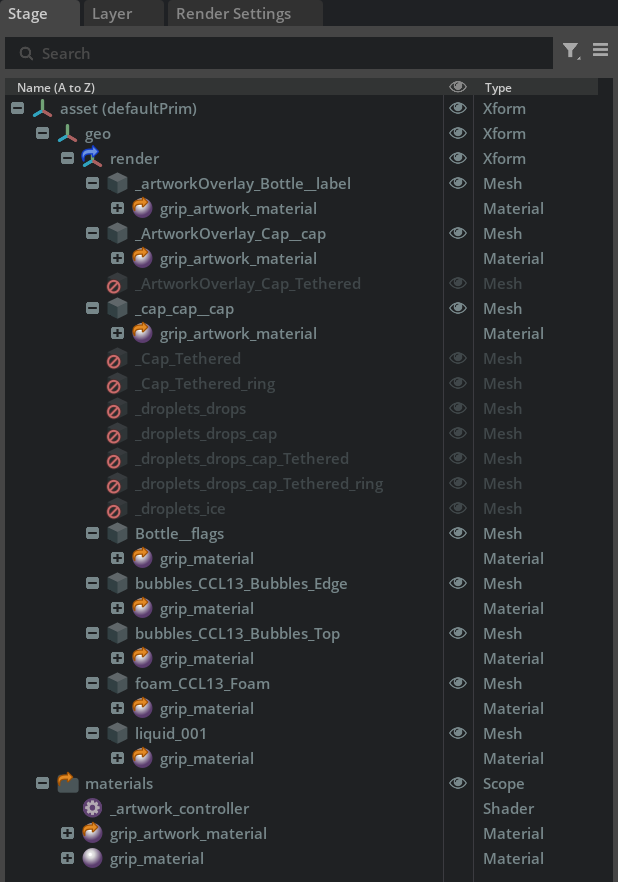
Example structure#
The screenshot below shows the stage structure in NVIDIA Omniverse, including all nodes and the deactivation of several mesh prims through shape variant selection.