USD Grip Material Implementations#
There are multiple OpenUSD implementations of the Grip material for different rendering contexts. Each implementation supports the full material feature set, although minor visual differences may occur between renderers because of the material’s complexity.
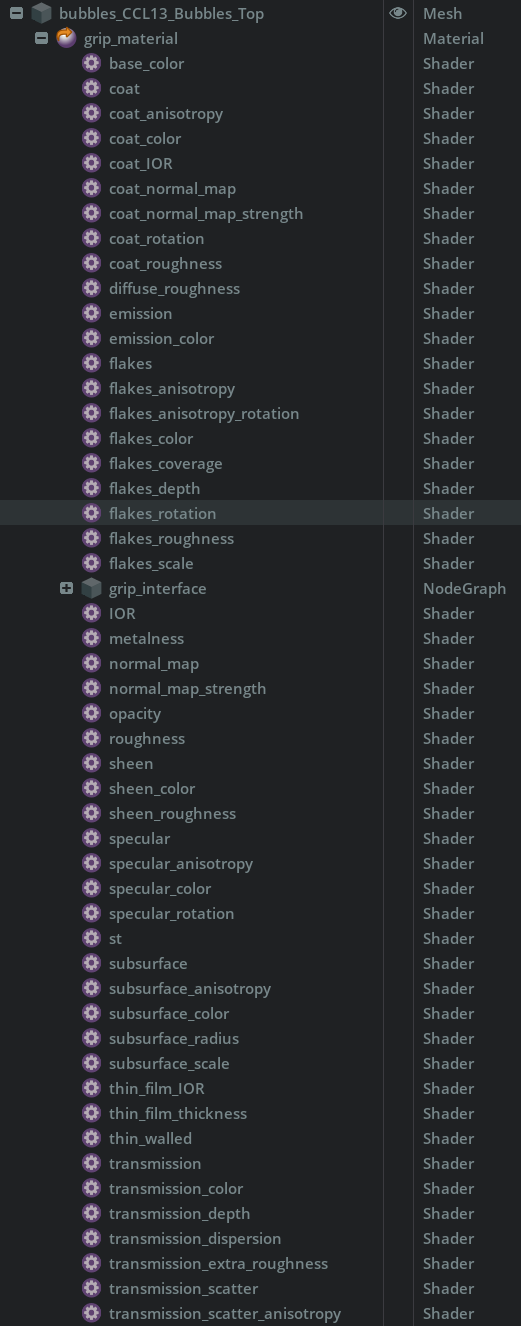
The image above shows the material in NVIDIA Omniverse. Each input is represented by a UsdUVTexture node, allowing the input to be driven by either an image texture or a single static value.
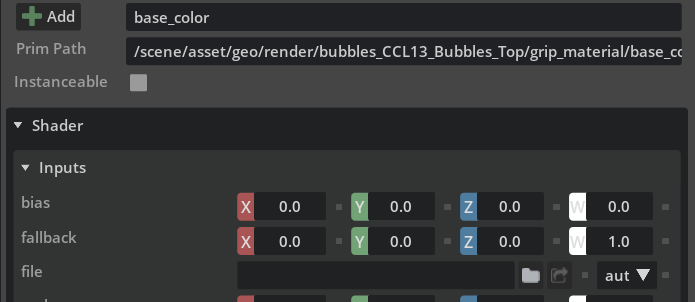
If the file attribute of a UsdUVTexture is set, the texture is used for that input. If file is not set, the fallback attribute supplies the shader input. Some inputs use scalar values, while others use color values. For a scalar input, set only the r (red) component of the fallback attribute, shown as X in the screenshot above.
NVidia MDL / Omniverse#
NVIDIA Omniverse uses NVIDIA MDL (Material Definition Language) as its primary shader language.
Our OpenUSD MDL implementation of the Grip Material fully supports all features.
Warning: NVIDIA Omniverse versions later than 106.5 have a bug that causes visual artifacts in refractions when using the Grip Material. The issue has been reported to NVIDIA, and a fix is expected in a future version.
Arnold#
Our OpenUSD Arnold implementation of the Grip Material fully supports all features.
OpenPBR / MaterialX#
The OpenPBR render context is supporting all features and uses a MaterialX-based shading network. It is suitable for DCCs / OpenUSD pipelines that support MaterialX 1.39.5 or later.